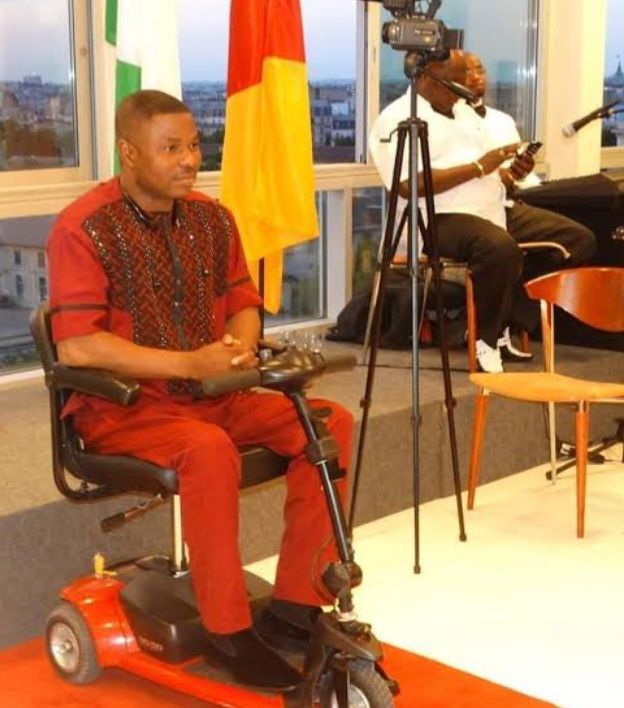
I was listening to Olalomi Amole and Komolafe Olaiya sometime last November and heard them describing Yinka Aiyefele as Dr. Aiyefele. I was in the company of some Nigerians and two of them asked if I knew where he obtained his PhD, his dissertation, supervisor, contribution to knowledge, etc.
I could not answer any of the questions as I knew nothing about Aiyefele other than the fact that when he had the accident that broke his spine, I joined others in contributing money for his hospitalization. However, I lost interest in him when he released a song that proved controversial, sort of accusing some people as the cause of his accident. Oga mi lo de fi kerengbe ran mi lo ni….
I made a few calls to some journalists to find out the details about his doctoral education. None could provide anything concrete, with many saying the doctorate might be honorary.
Clearly, not many Nigerians know that one PhD is earned while the other is an honorary title. To make it clear, let me provide the following:
A PhD, or Doctor of Philosophy, is an advanced academic degree awarded by universities. It represents a significant contribution to knowledge and is achieved through extensive research that culminates in a dissertation or thesis, which must be defended before a panel of experts in the field. The process of earning a PhD typically involves several years of study beyond a master’s degree, requiring the candidate to demonstrate a deep understanding of their subject area, the ability to conduct independent research, and the capability to produce work that adds to the existing body of knowledge in their discipline.
On the other hand, a PhD (honoris causa), or Doctor of Philosophy “for the sake of honor,” is an honorary degree. It is awarded to individuals without the need for completion of the usual requirements of a PhD, such as coursework, research, and a dissertation. Universities confer honorary degrees to recognize individuals who have made significant contributions to a particular field or society at large, through their professional achievements, public service, or other meritorious activities. The honoris causa degree is symbolic and does not confer the same academic status as an earned PhD, but it acknowledges the recipient’s exceptional impact or accomplishments.
The difference between the two is clear: one is a gift that recognizes contributions while the other is earned after intensive education, the writing of a dissertation, etc.
I know most Nigerians are title-devouring people. However, by convention and practice, if Aiyefele’s PhD is an Honoris Causa, it has to be added to signify that it was an honor.
One can only address him as Dr. Aiyefele if he studied and earned it with the writing of a dissertation. If Yinka Aiyefele’s PhD is honoris causa, then any time he is referred to as a PhD holder, it has to be followed with “honoris causa.”
In the Netherlands, a PhD holder holding a teaching position is addressed as Prof. (Dr.) Ojo. In the US, any teacher in the university is called a Professor.
In the Netherlands, a PhD holder holding a teaching position is addressed as Prof. (Dr.) Ojo. In the US, any teacher in the university is called a Professor, not minding if he or she has only a Master’s degree. So, if Ojo signs a letter with “Professor Ojo,” it means Ojo teaches in the university.A PhD is the highest educational degree anyone can attain. The honorific PhD is not the same as the earned one; hence, the addition of “honoris causa.”In Nigeria, adulation is a common culture, and with almost everyone parading PhDs, I won’t be surprised one day when a plank seller with a “Pay4Play” PhD from Cotonou applies for positions in the university or applying to be Vice Chancellor of the University of Ibadan. After all, a doctor is a doctor.


 DAEHIN PRODUCTION